I have written, rewritten, and rewritten this post over and over again. Not because the facts are complicated, but because I want to get the tone exactly right.
I have also considered not writing it at all, because I don't want to come across as defensive or insincere. But it's time to get my thoughts on the record: what happened at Xinja, what Australia's banking regulator decided, why I dispute their determination, and why I settled anyway. I will separate, carefully, what is public record from what is my own contested position so you can weigh both.
If you have read My Story, you know the context in which this chapter unfolded. If you haven't, the short version is that much of it happened while I was recovering from a stroke that nearly killed me.
The Xinja journey
Between 2017 and 2020, I served as a non-executive director of Xinja Bank, one of Australia's first new digital challenger banks. I joined because I believed in the idea. Australian retail banking is dominated by four very large institutions, and Xinja set out to build something genuinely customer-first: a digital bank designed around the people who used it.
Parts of it worked. At its peak, Xinja held roughly A$480 to 500 million in deposits across around 47,000 accounts, built in a remarkably short time. Australians wanted what Xinja was offering.
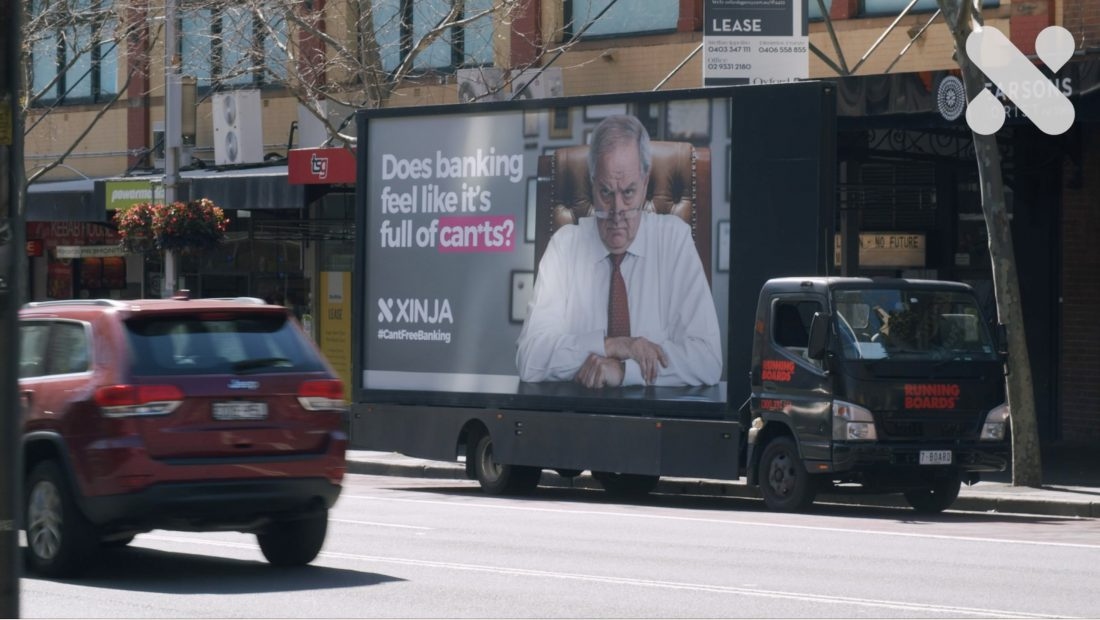
Our marketing said the quiet part out loud. Campaigns like “Ditch dad banking” and “Does banking feel like it's full of can'ts?” were a deliberate challenge to the incumbents. Customers loved it. The industry, less so. That was rather the point: we were building the bank the big four were not.

Ultimately the economics did not hold. Sustaining a new bank requires capital on a scale and schedule that proved beyond us, particularly as COVID arrived and global capital markets seized. In late 2020, the board confronted reality and made the hardest call available: to close the bank voluntarily, return every deposit, and hand back the banking licence.
Australians wanted what Xinja was offering. Ultimately the economics did not hold.
There were many lessons at the time, good and bad, and even more later after time for reflection. Here I have shared ten founder lessons I learned from being involved with the build of a challenger bank. I have also shared more personal reflections as a director and how I am taking the leadership lessons forward.
The “successful failure”
In December 2020, Xinja began Australia's first voluntary return of deposits by a licensed bank. By 19 January 2021, it was complete. By the time we closed, customers held roughly A$252 million with us. Every dollar was returned in full, to around 37,900 people. No depositor lost a cent. No call was made on the Australian Government's deposit guarantee scheme. There was no contagion to any other part of the financial system.
Wayne Byres, then the chair of APRA, Australia's banking regulator, described the outcome publicly a few months later as a “successful failure.” His words are on the record, and I have always been grateful for them, because they are accurate. The harm a banking regulator exists above all to prevent, loss to depositors, never occurred.
“The recent small case of Xinja is a handy illustration of successful resolution. When it became clear that the bank's trajectory was unsustainable, APRA worked closely with the Xinja board to resolve the bank by returning deposits in full and in a timely and orderly manner, ensuring no depositor lost money and there was no contagion to other parts of the system. From my perspective, it was a successful failure.”
Wayne Byres, then APRA Chair, 2021 AFR Banking Summit. Read the speech on APRA's site
I worked long and hard on that outcome, and it remains one of the proudest achievements of my career. Plenty of institutions, including banks, have failed in ways that hurt people. Xinja is the rare failure that hurt no customer at all.
The investigation & findings
After the closure, APRA commenced an investigation into Xinja's final capital raisings between May and August 2020. The investigation ran for years. For much of that time I was in hospital or rehabilitation. However, I participated fully in APRA's enquiry throughout, attending interviews and responding to requests, often against my doctors' advice. Bound by strict confidentiality obligations, I carried the weight of this alone, unable to discuss it with anyone, including my wife.
In October 2025, APRA announced the settlement and their determination against me which included disqualification from working as an accountable person of any authorised Australian deposit-taking institution for ten years. The process was run and judged by APRA under the Financial Accountability Regime, a framework introduced in 2024. APRA claimed that I failed to act with honesty and integrity, and that I altered a document provided to its investigator.
Their choice of language was damning, and it drove the headlines, the only part of this story not behind a paywall. I will address the findings directly here because even though my position has been consistent and public since the day the decision was announced, any recounting of that is hidden behind paywalls.
My position, on the record
Capital raise practices
The capital raise in question involved two investors engaged as intermediaries, a common and permitted practice. While APRA concluded these roles were not genuine, my position remains that the roles were legitimate. In fact, both of the investors in question confirmed through the APRA review that they were acting as intermediaries, and the bank's wind-up simply concluded before their work could yield results.
It's also important to note that throughout this process, the board and I relied on guidance regarding disclosure requirements from the bank's legal and compliance experts, and the external Tier 1 experts advising them. I believed that we had operated appropriately.
Document alteration
I need to address the accusation that I 'altered a document' head-on, which has been presented as a sign of dishonesty.
While assisting investigators during the December 2020 wind-down, I provided an email that I had truncated to remove irrelevant content. However, the complete, unedited version had been available to APRA for months; nothing was hidden, and its meaning remained unchanged. While this edit technically falls under the strict definition of 'altering' within banking law, the implication of dishonesty is wrong. It was a mistake in judgment regarding completeness during a high-pressure wind-down, not an intentional deception.
The record, in brief
Craig Swanger and the Xinja case: the facts
- Xinja's closure was a ‘successful failure’: every cent of customer deposits was repaid in full, no call was made on the government's guarantee scheme, and the broader financial system remained unaffected.
- APRA's review process of Xinja and its findings were administrative, not criminal, and were not tried in court.
- The investigation and determination were self-adjudicated by APRA and have never been subject to independent scrutiny.
- I continue to dispute APRA's findings. Settling the case was a health-driven necessity, not an acceptance of the findings.
- The use of words like dishonest in the APRA media release characterised the findings and my behaviour in a way that is not consistent with the layperson's meaning of the word.
- I expected to be vindicated by an independent tribunal, but my health, alongside the unpredictable timeline and costs, made continuing the process untenable.
- It has never been suggested that I personally benefited in any way from any of the matters investigated, by APRA or anyone else.
- Long after Xinja ceased operations, I spent years working pro bono, focused entirely on ensuring a fair outcome for our investors.
Why I settled
I am often asked, “if you dispute the findings, why did you settle?” It's a good question and my answer is simple:
I accepted a settlement with a powerful regulator I did not have the resources to fight. I did not, and do not, accept the findings. I chose my family and my health.
I had the right to an independent review, and I was confident I would be vindicated there. But that process was expected to take another eighteen months. By that point, I had already spent years under investigation while recovering from a bilateral stroke, a coma, and major heart surgery. My doctors' advice was blunt and unanimous: the sustained stress of fighting would carry an unacceptable risk of another life-threatening stroke.
Suddenly this choice was not about regulation anymore. I was weighing the chance to clear my name against my health and my family's best interests. I chose my family. It's a decision I have often regretted given the personal impact, but I had no real choice.
It's important to remember that in this case a corporation was not on trial with teams of lawyers and deep pockets to mount a defence against a government department. In this case, there were just three individuals mounting a defence with limited support and resources, years after the fact. It was a case of harpooning a goldfish. We could never win.
I accepted a settlement, but let me be precise: I do not accept the findings. Settling a matter to protect your life is not the same as accepting what was alleged.
It was a case of harpooning a goldfish. We could never win.
On process, briefly
I respect APRA and the vital role it plays. A safe banking system is the bedrock of my career, and I believe in strong prudential regulation. However, I need to make one observation about the process, not as a grievance, but as a matter of public record.
Under the current framework, disqualification is an administrative decision made by the regulator that conducted the investigation. In short: the investigator is also the judge, and it takes effect without any court involvement. It's worth noting that in the most prominent modern case where APRA's disqualification arguments were tested in the Federal Court, the case was dismissed in full. At the time, the court found that APRA's case was “unpersuasive” and had failed to prove the contraventions they'd concluded in their administrative review.
This lack of independent testing hasn't gone unnoticed. Writing in The Australian in December 2025, business journalist David Ross set my disqualification, and Eric Wilson's, against the regulator's wider enforcement record: the regulator ‘has not secured any enforceable undertakings against any individual in 12 years.’
“APRA has also used its powers under the Financial Accountability Regime twice since they were gifted to the regulator in 2024. Taking the scalps of two former bankers, Xinja Bank boss Eric Wilson and director Craig Swanger, many years after the failure of their neobank is not the kind of deterrence the financial sector needs. Xinja handed back its deposits in 2021. How many financial services scandals have we seen since?”
David Ross, “APRA's soft enforcement track record, 10 years after banking royal commission”, The Australian, 8 December 2025.
None of that proves what a tribunal would have decided in my case, but it explains why I place such weight on the fact that my findings were never independently tested, and why I was confident about that review.